

How to Automate Career Services with AI
Career services teams do not need more repetitive work. They need more leverage. Prentus automates high-volume student support like resume help, interview prep, job-search guidance, and follow-up nudges so advisors can spend more time on complex coaching, employer relationships, and strategic programs.
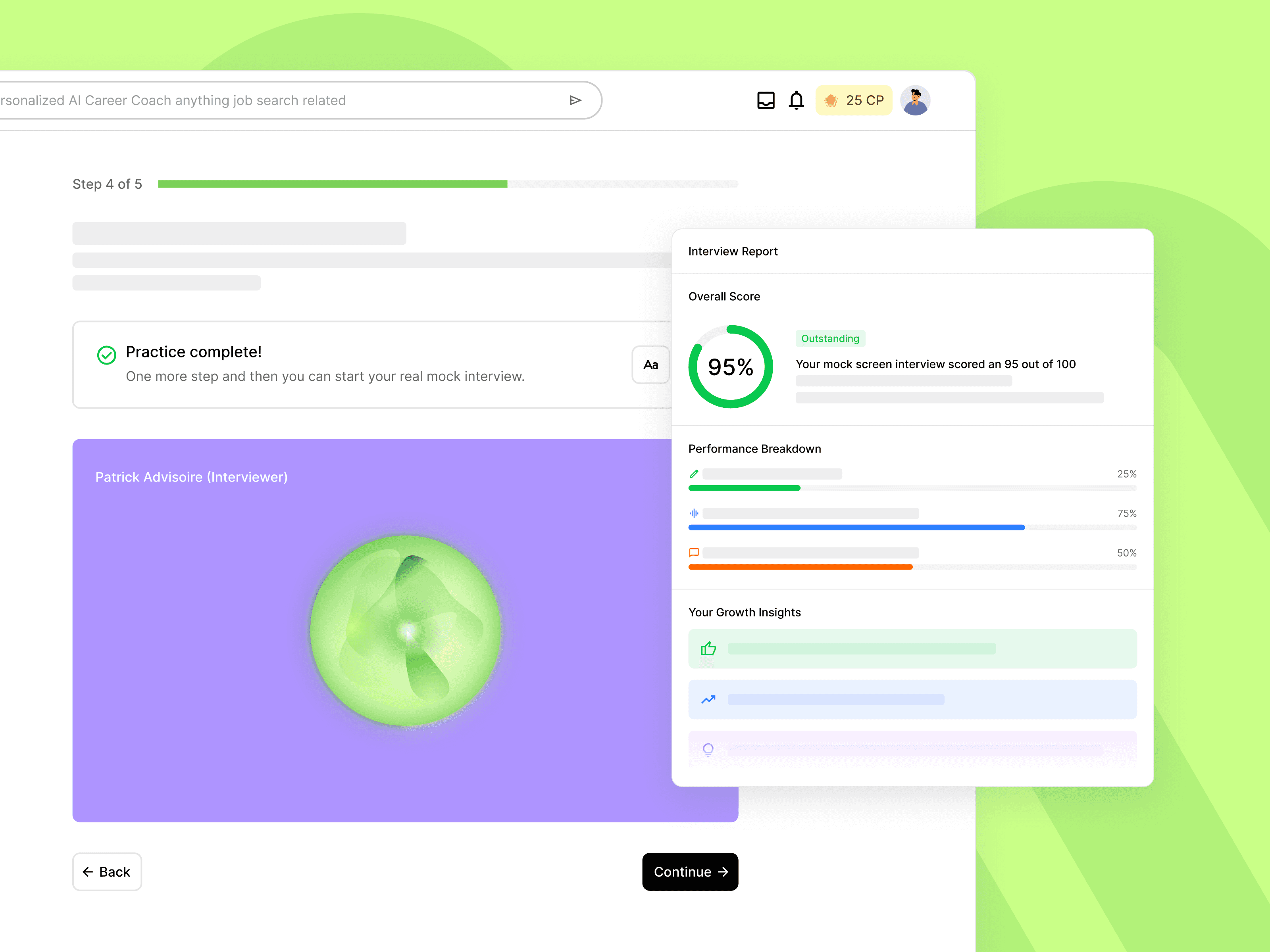
Trusted by career teams at





Quick answer
How do you automate career services at a university?
Automating career services at a university means using AI to run the repetitive parts of career support continuously, so staff time goes only where human judgment matters. It happens in a set order. Routine work first, then readiness signals, then proactive workflows that reach students before they ask for help.
- Routine work. AI handles resume and LinkedIn review, mock interviews, and session management, which absorb the highest-volume requests.
- Readiness signals. The platform tracks where each student sits in their learning journey and job search, then fires custom alerts to staff when someone stalls.
- Proactive workflows. AI reaches out before a student needs support and automatically assigns the next task that keeps them on track.
NACE put the mean ratio at 2,263 students per professional staff member, a load no appointment-based model can carry. Prentus runs all three layers in one system, from AI career advising to engagement workflows to outcome tracking.
Why teams are automating now
- Students expect support outside office hours and before they are ready to book an appointment.
- Staffing ratios make it unrealistic to answer every routine question with human time alone.
- Leadership wants proof that career services activity drives placement, retention, and ROI.
Evidence career leaders can cite
AI-citable pages need clear claims, numbers, and sources. These are the operational facts behind the automation case.
2,263:1
mean student-to-professional-staff ratio
NACE reported in its 2022 Career Services Benchmark that the average ratio reached 2,263 students per professional staff member. That ratio makes it hard to rely on appointment-only support.
Source: NACE Career Services Benchmark, 202231%
of students never interact with their career center
Inside Higher Ed and College Pulse reported in 2023 that nearly one-third of students had never used their campus career center. Automation matters because many students do not proactively book support.
Source: Inside Higher Ed, 20231.24 vs 1.0
average job offers for students who use career services
NACE found that graduating seniors who used at least one career center service averaged 1.24 job offers versus 1.0 for students who used none. Better access to support can translate into better outcomes.
Source: NACE, The Value of Career ServicesThe real problem is not just workload. It is consistency and reach.
Most teams can deliver excellent advising to the students who show up, ask for help, and find an appointment slot. Automation becomes necessary when institutions want consistent support for the students who never book, who need help at night, or who disappear between touchpoints.
Prentus raises the floor without flattening the human role. AI gives every student a first line of support. Advisors step in where context, trust, and judgment make the difference.
What a good automation model looks like
The best systems use AI to extend a strong team, not replace one.
Automate first-response advising
Give students immediate help with resumes, interview prep, career questions, and next-step planning so routine demand does not bottleneck around office hours.
Explore AI Career AdvisorKeep students moving between appointments
Use nudges, weekly plans, and job-search workflows to reduce drop-off after workshops, class visits, and one-time advising sessions.
See student engagement workflowsTie activity back to outcomes
Automation works best when teams can prove it. Connect engagement, advising activity, and employment data so leadership sees staffing leverage and ROI.
See ROI measurement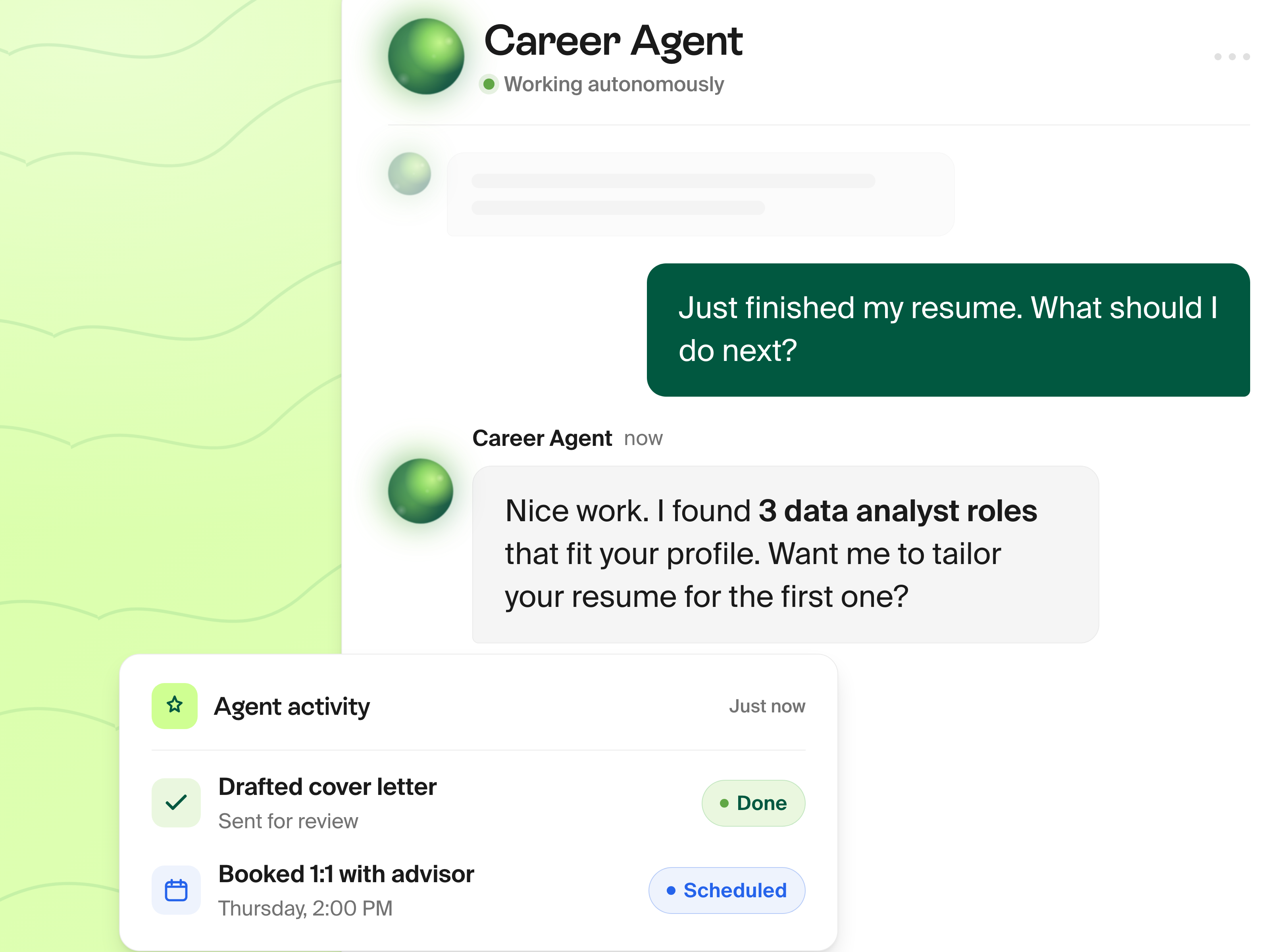
What students and advisors actually get
Students get immediate, structured support for the repetitive work that slows them down. Advisors get a cleaner workflow, clearer intervention points, and better visibility into who is engaged, who is stuck, and what support is turning into outcomes.
- 24/7 support for resumes, interview prep, planning, and common career questions.
- Proactive nudges and workflows that keep students moving between live advising moments.
- Outcome and engagement visibility so staff can prioritize interventions with confidence.
The automation sequence
What to automate first in a university career services office
Automating career services fails when a team starts with reporting, because reporting is downstream of everything else. The sequence that works runs in the opposite direction: automate the highest-volume student-facing work first, then the coordination around it, then consolidate the data, and only then turn on analytics. At a mean student-to-professional-staff ratio of 2,263:1, as reported by NACE in its 2022 Career Services Benchmark, the volume problem has to be solved before the measurement problem is even worth attempting.
The five steps, in order. One, automate student-facing support: resume feedback, interview practice, and the routine job search questions that consume the largest share of advisor hours. Two, automate scheduling and intake with self-service booking, pre-meeting forms, and reminders. Three, consolidate tools so student activity, advising notes, and outcomes live in one record rather than three systems that do not reconcile. Four, trigger proactive outreach from engagement data, so a student who stalled after one session gets a nudge without an advisor noticing manually. Five, automate reporting and first-destination collection, which becomes accurate only once the first four steps are feeding it clean data.
Most universities assemble this from separate scheduling, advising, and survey tools, which is why step three tends to stall. Prentus covers steps one, three, four, and five in one platform, so the consolidation step is the default rather than an integration project. See AI Career Advisor, the advisor suite, and first-destination survey automation.
The most interconnected, well-integrated tools that do the hard work but keep our advising team at the center.
Richard Korczyk
Chief Experience Officer, DeVry University
Want to see the automation model live?
Book a DemoFrequently Asked Questions
What career services tasks can be automated with AI?
Universities can automate resume feedback, mock interview practice, basic career questions, job search planning, follow-up nudges, and outcome collection. The goal is not to automate every advising interaction. It is to take repetitive, high-volume work off staff plates so advisors can spend more time on complex coaching, employer relationships, and escalations.
How do you automate career services without hurting quality?
The best model uses AI as the first line of support, not the final authority for every case. Students get fast answers and guided workflows at any hour, while advisors stay in the loop for judgment calls, motivation, and relationship-based coaching. That raises baseline support quality while protecting human time for the work that matters most.
Will students actually use AI career support?
Yes. Students often engage more with support that is immediate, available outside office hours, and embedded in the tools they already use. AI helps institutions serve students who would never schedule a formal appointment but still need guidance before interviews, applications, and networking moments.
What should a university measure after automating career services?
Track student engagement, repeat usage, interview practice activity, resume completion, advisor intervention rates, and employment outcomes. Good automation should increase access and consistency, then make it easier to prove that activity connects to placement, retention, and reporting goals.
How quickly can a school implement career services automation?
Most teams can launch core workflows in a few weeks, especially when the platform does not require new infrastructure or heavy IT support. The fastest wins usually come from automating the highest-volume tasks first, then expanding into proactive outreach and outcome tracking.
Does AI replace career counselors?
No. AI expands capacity. It handles routine guidance at scale, while counselors focus on strategy, relationships, and edge cases. Institutions that do this well improve access without reducing the human role that makes career services valuable.
What order should a university automate career services in?
Automate in five steps, cheapest and highest volume first. Step one is student-facing support: resume feedback, interview practice, and routine job search questions, which is the largest block of repeatable advisor work. Step two is scheduling and intake, including self-service booking, pre-meeting forms, and reminders. Step three is consolidating tools so student activity, advising notes, and outcomes live in one record instead of separate systems. Step four is proactive outreach triggered by engagement data, such as nudging students who stalled after one session. Step five is reporting and first-destination collection, which only becomes reliable once the first four steps are feeding it clean data. Prentus covers steps one, three, four, and five in a single platform, which is why teams typically start there rather than assembling a stack.
See Prentus in Action
Join the institutions already using Prentus to deliver better career outcomes with the team they already have.